
ABS failure after wheel bearing replacement – a common assembly error that is easy to avoid
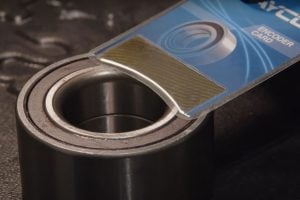 Although this issue has been known in the automotive industry for a long time, complications related to improper installation of wheel bearings still occur in workshops. Usually, the error quickly becomes apparent as a warning light appears on the vehicle’s dashboard, indicating a malfunction in the ABS system.
What do wheel bearings and ABS have in common?
ABS (Anti-lock Braking System) is one of the fundamental safety systems in vehicles. In short, it prevents the wheels from locking up during braking. ABS can shorten braking distances by several meters under certain conditions.
The ABS, along with other vehicle systems like ESP, relies on magnetic sensors located in the wheels. These sensors measure the rotational speed of the wheels, and thus their grip on the road surface. For example, if the ABS system is active and a wheel loses grip, the sensor sends a signal to the vehicle’s central computer, which adjusts the brake system pressure accordingly.
Most of the vehicles in the European fleet are equipped with so-called active wheel speed sensors. They work with magnetic rings that are integrated into the wheel bearings. And that brings us to the point where extra caution is needed to avoid a simple mistake that could result in an improperly performed repair.
A simple but very useful tool – the encoder card (Dayco Tool 19)
The first thing you need to do is check the orientation of the sensor encoder and wheel bearing. As mentioned earlier, in some bearings, the magnetic sensor is embedded in the seal. If you install the bearing backwards, with the seal and encoder facing away from the sensor, the sensor won’t be able to measure the wheel speed. Furthermore, once installed incorrectly, you can’t simply remove the bearing and reverse its orientation, as doing so might damage the seals, meaning you’ll need to purchase a new bearing. To ensure proper installation, you can use an encoder card. Dayco offers a handy tool called the Dayco Tool 19. Place it against the side of the bearing, and the magnets along with the encoder will create a pattern in the detector.
This card not only helps locate the side of the bearing with the sensor encoder, but it also serves another important function: it allows you to check whether the magnetic ring itself is damaged. While the correct side of the bearing can be identified in other ways – for example, by applying a piece of metal to the bearing surface to see if it is attracted (but still this is not the recommended solution) – the magnetic ring cannot be visually “scanned” without the proper tool, which in this case is the encoder card.
Discover the Dayco comprehensive range of wheel bearing kits
Dayco is rightly recognized as a world-leader in drive system design and production. However, Dayco also offers a wide range of wheel bearing kits that marks a significant, but natural step for Dayco, to add safety related products alongside its established engine an drive systems expertise. However, what many may not know is that Dayco also offers a wide range of other high-quality parts, including its comprehensive range of wheel bearing kits, which provide complete solutions for the workshops. Special attention has been given to ensuring that all necessary mounting accessories are included in the kit. While the
range of Dayco kits offers broad coverage for the European car fleet, it is also designed to address niche applications.
To find the right parts, use the Find your Part. You can search for parts from the Dayco Catalogue that are compatible with a specific vehicle, along with assembly instructions and other useful technical information and tips.